Tuesday, December 14, 2010

Pictures of My Country Kitchen.

My kitchen fire place with Staffordshire.

Staffordshire dogs on the jelly cupboard.


The little Princess on a Staffordshire dog.


Bessie the Cow.

Cow Creamers.


A wall in my Country Kitchen.


German Meissen.


Some of my Childrens Chairs.

Italian Life Sized Chikens on the Island.


English Spode.

Some of my Brass Scales.

Gigham Curtains with French Brass Valances and Tie backs.

I love Baskets.


American Blue and Gray crockery.


Mine and Sissy;s  Chair..
 

Thursday, December 9, 2010

Quest for a Lambrequin

Lambrequin at Elgin / Cottrell House


 Antique piece I found as a pattern
Parlor at the Confederate White House


Mrs.Jefferson Davis, First Lady of Conderates


Sissy Dog on a chair she should not be on.


Gentlemans or Upriver parlor at Elgin/ Cottrell House with my lambrequin.


Curtains made to match Lambrequin
In late spring of 1861-Richmond Virginia, became the capital of the Confederate States of America, and with that title came responsiblities to have a new congress,goverment offices and a President-Jefferson Davis. Davis,his wife,their children and various staff memebers were housed in the newly purchased Confederate White House at the corner of 5th and K street. The previous owner had just added a third floor and redecorated the interior of his home. He sold the house and furniture for $43,000.00, to the Richmond City authorties- which then rented it to the Confederate Governorment as an Executive Mansion. Davis and his 35 year old wife,Varina and there children made this there new home for the next four years. The house was made into a museum in 1890-only a few years after the war. Mrs. Davis was of much help with this project. And today it is one of the most intact Historic homes in America. I used this house as my Bible, when restoring my own historic house, the Elgin / Cottrell House.
   When I visited the Conferdate White House many years ago,I was taken by the wonderful needlepoint Lambrequins that were on the fireplaces. They were all hand stitched by Varina Davis, and they were still hanging in place after all these years.
  Well to make a long story shot, I wanted a Lambrequin for my  historic home,so I went on a quest to find one. I looked in antique shops, on line,called pickers in Europe,but, none was to be found. Luck was with me when I found  a small needlepoint clock shelf, Lambrequin ,at an antique show in Chicago. Being affordable, I bought it and decided to use it as a pattern and make my own Lambrequin.
   For those of you ,who do not know, what a lambrequin is: This is the Websters Dictionarys defination: A kind of pendent,scarf,or covering attached to the  fireplace mantle to protect it from heat. An ornament or drapery or short decorative hanging from a shelf or fireplace mantle. Some times known as a cornice, pelment or valance.
    Opulent Victorian Homes of the Antebellum period had such decorations on there mantles-these  kept smoke from the fireplace ,off the marble or wood mantle.Most often made by the owners of the home. They would purchase charts  for the designs, by mail order. Most came from Europe,and needlepoint was the method. Some Lambrequins were just cloth to match the drapery. 
    For my Lambrequin, I drew the pattern on graph paper,using the piece that I found in the antique shop. I made a chart for the colors  and worked one at a time ,untill the design was done. The black background was done last. After weeks and weeks of work and counting stitches, the Lambrequin was still not big enough for my mantle. I could not stand to do one more block, so I decided to make the middle one different, and it made it much more interesting to do. The edges were finished off with black bias tape, sewn to the back, turned under and stitched down. It was trimed out with black silk cords and tassels. I used a basket weave needlepoint stitch, it does not distort the canvas, so there was no need to block the piece. Someday, 100 or so years from now, some one else might  be inspired by my Lambrequin, like I was, by Mrs. Davis work. At least I know as long as I own my historic house it will be on display and shared by everyone who comes to take a tour.I  designed the curtains for this room to match the Lambrequin. They were made by my dear sister. Same pattern was used for the outline design. The Lambrequin hangs on the mantle of the fireplace in the Down River or Gentlemans Parlor. My dog Sissy had to get in on the action.

Sunday, December 5, 2010

Needlepoint Collection in the Up River Parlor Part II

Needlepoint Girl with Dog.

Needlepoint Face Fan.

 French Beaded Needlepoint Bed Step.


Beaded Needlepoint Picture of a Cherub.
  More pictures of the Victorian Period needlepoint in the Up River or Ladies Parlor at my old historic house, the 1845 Elgin/ Cottrell House in Clarksville,Mo. Call anytime to arrange a tour. Thanks, Richard Cottrell 573-242-9688

Needlepoint collection in the Up River Parlor

    When I was in college I  took a  class titled,"Art Needlework." The teacher was Ms. Gooch. It was in the Home Ec. department of the college. Well you can just imagine the look on the teacher and the other students faces, when I walked into class the first day. Of course ,I was the only male student! We  studied many types of needlework. The one that I enjoyed the most was Needlepoint. During the rest of my college years and many afterwards, I did a lot of needlepoint. Being an art major, I soon got into painting the designs on canvas for people. I also did custom work for many. One of the most unusual was a stool seat cover to match a ladies wall paper in her powder room. After I moved on from my needlepoint stage, I developed a great passion for antique needlepoint. As the years passed my collection grew and I have quite a bunch. The pieces that I am highlighting today are all in my historic house, in its up river or ladies parlor.
    A little history about needlepoint first. Needlepoint can be traced back in history as far as the Egyptians. Pieces were found in a Paroahs tomb that dated back 1500 years before Christ. The actual name, "needlepoint," did not exsit until 1869. Before that it was called Berlin Work or just needlework.
    The degree of the design in needlework depends on the thread count of the underlying mess fabric. A fine canvas is known as petit point, and a split mess is gross point. Gross point is usually done with silk or cotton thread, regualar needlepoint is done with wool yarn. The petit point can be done with either split wool or several thickness of thread. Sometimes a metaelic cord or braid is added. Often beads were introduced. The needle would pull up through the canvas, a bead would go on, and then the needle down through the canvas. This would be a much smaller needle and a silk thread would be used. There is three type of stictches. basket weave,continetial and half cross. The continental is the most popular. Advance needlponters often choice the basket weave. It takes more yarn, but does not distort the canvas as much, so blocking is easier. And is very neat on the back. The yarn makes a basket weave pattern if done correctly.Today the paterns come printed onto the canvas. So one just matches the colors. Some people paint there own. In the Victorian days when my collection of needlepoint was done, they did what is known as Charted. These charts were available in some stores, but were mostly ordered through the mail. Most came from England and France. Each stitch had to be counted, color by color for the main design. When that was done the plain background color could be added.
   Famous needlepointers in history were, Mary Queen of Scott, Queen Mary ,Queen Victoria and Grace Kelly.
   The Victorians of Europe and America were very good needlepointers, keep in mind it was a form of entertainment as they had no TV sets in those days. Also keep in mind that the lighting of that period was not good. A lot of ladies of that period were not permitted to go to college. Instead they would attend a finishing school. In these schools they would study art. One form of that art was needlework. As a final art project before they were to gradulate, they would make a wonderfull  final project. A lot of the fine examples of antique needlpoint that we have today, are a result of those projects.
    All kinds of things were needlepointed. Pillows,bell pulls, tea caddys, furniture, trivets, even some clothing and shoes.
   The needlepoint collection that I am highlighting today, is all from the Victorian years. Queen Victoria set on the throne of England from 1831 to 1901. Those years were known as the Victorian Years.
Needle point Face Fan from New Orleans.


Table top Face fan from England.

Upriver or Ladied Parlor at Elgin/Cottrell House.

English Beaded Needlepoint Trivet.


Face Fan from France.


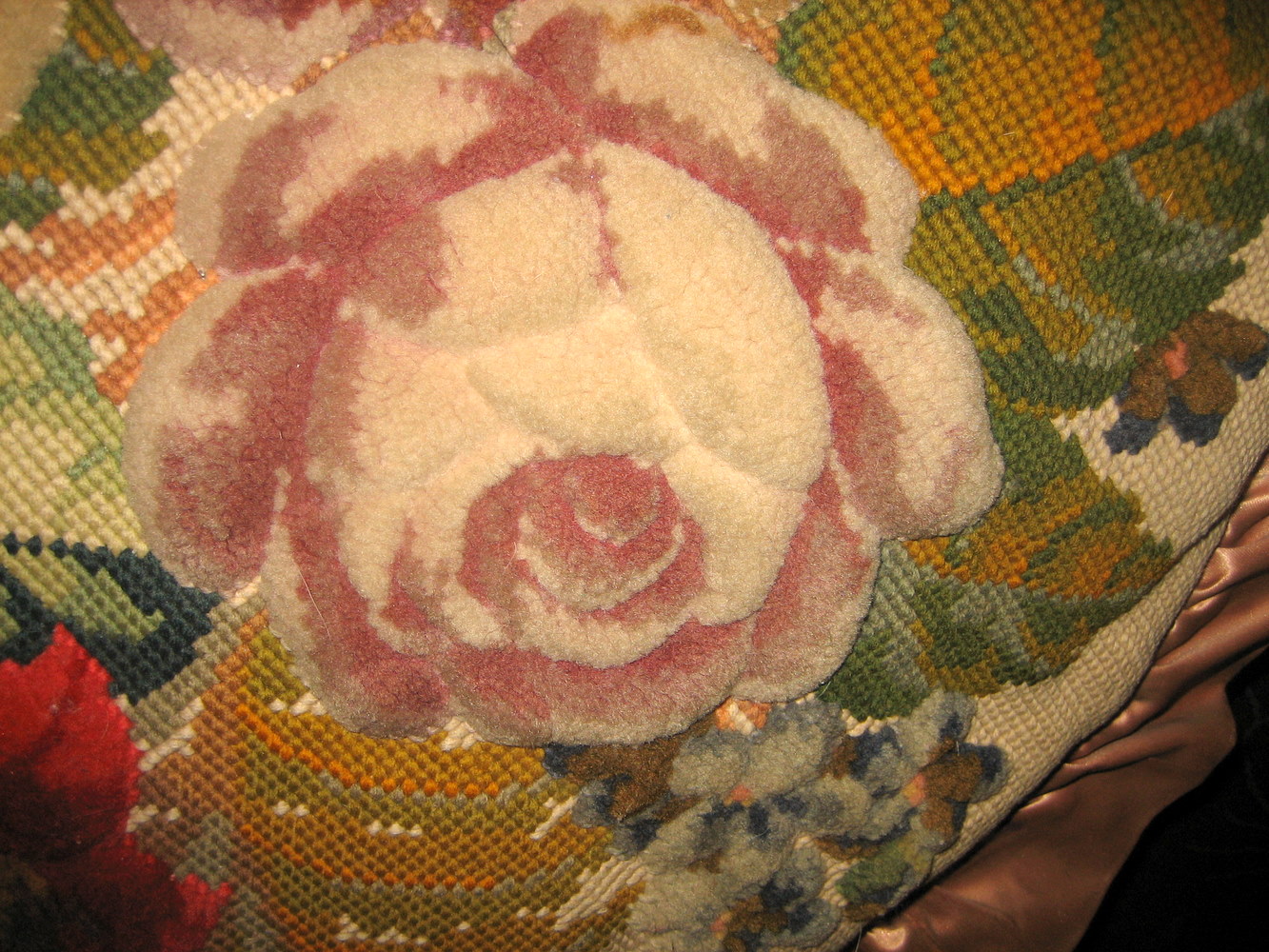
Berlin Worked Needlepoint Pillow with Roses.


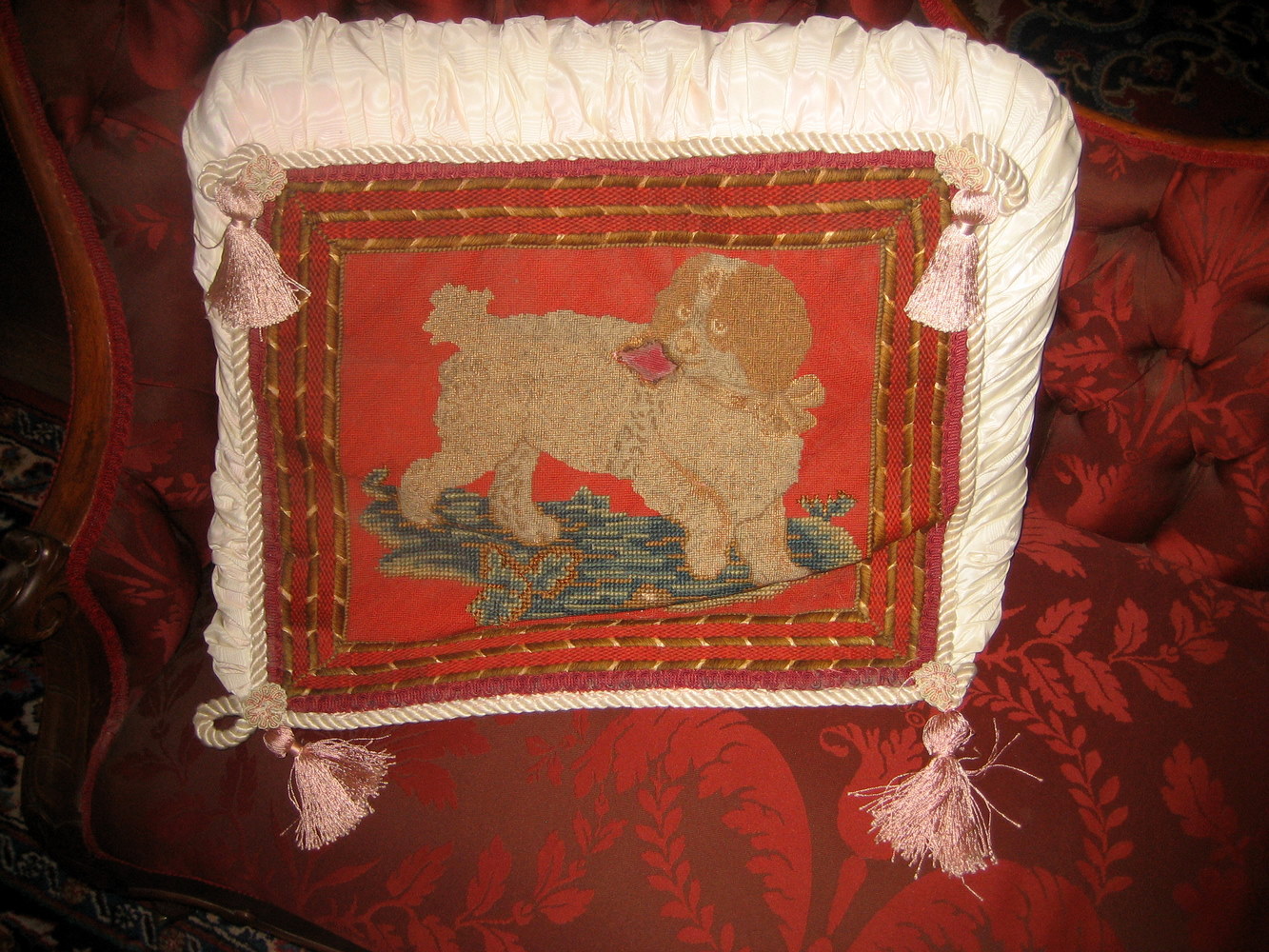
English Needlepoint of a king Charles Spanel.


My Upriver or Ladies Parlor at Elgin/Cottrell House.
   My favorite antique needlepoint are  the pieces that have bead work or stump work. I have loved it for years and every time a see a piece for sale, it is hard to say no. I do pick it up and hold it for awhile. Having done a lot of needlepoint, I know what went into each of these pieces. And the fact, that it has been around so long. Well! I hope you enjoy the pieces as much as I do.