Monday, November 7, 2011

Next Course Please!

Hand painted ICE CREAM set. Large platter and 12 bowls. Royal Austria, circa 1860-1890.

Bavaria ,Germany Berry Set, Hand Painted. fruit and berries. Circa 1890-1900.

French Limoge Game Bird set. Circa 1860-1890.

French Limoge hand painted fish platter,

English ,Minton  China  Desert set, 4 cake plates, 3 bowls, 24 cups and saucers in two sizes for various uses. Circa 1890-1900.


  Queen Victoria was not born to be the Queen of England. Her Uncle, the King, had no children,so Victoria, being next in line for the throne, was groomed from a very early age to be Queen.. Her uncle died when she was 16, making her the Queen of England. She reigned for 80 years,making her the longest reigning Queen to this date. During her reign, she had a great influence on the styles of that day, thus the Victorian Era was born. All over the world, everyone wanted to live, dress and be like the young  Queen Victoria.
        Dining table etiquette was one aspect of manners that the Victorian era women were concerned with. The linens and utensils had to be clean, polished and  folded just right. Even the salt was expected to look neat and have it's own container. The goal of the Victorian lady, in that period ,was to serve others, and her etiquette and manners, all helped her do so. Anything she did was to please her husband and  society. Married couples were never seated together. It was considered ridiculous to make a display of a napkin. They should be pressed and folded in fourths and laid in the center of the service plate.
   Serving was always done by a maid, footman or the butler. The lady of the house would never do the serving. Courses were brought around behind the quest back and served from the left. Food was served in courses. Salad,game.fish,main,fruit, and desert. All china was removed from the dining table before the next course. The main china was only used to serve the main course, usually beef with a side  vegetable. Special sets of china were designed, painted and made for each course. The soup course consisted of a tureen,bowls and under plates.The fruit course was often served in what we call a berry set. A large bowl with numerous small side bowls.Some of these sets had fruit and berries  hand painted on them ,where others had flowers. A  fish set, comprised of a large serving platter, sauce boat and 6 to 12 small plates,  used for serving the fish course. More often than not, these sets were decorated with hand pained fish. The same applied to the game set, which featured various game bird  paintings. Desert sets were used for various deserts and were made up of several cake plates, bowls for sauce and various sizes of cups and saucers. Nuts were often served between courses and nut sets decorated with hand painted nuts were made for this course.
   Today most of these fancy sets are not used so much for serving course. They are just displayed very proudly in there owners homes. Times have changed so much and very few people entertain in there homes  much any more. Most dinner parties take place at private clubs. Even if a dinner party is held in a home, very few host serve in courses. Most home owners want serving things that can go in a dishwasher, as the servants of the Victorian era, are no longer serving in homes ,as they once did.Most American homes put all the courses on the table at once and they are passed around. Family style.


Ice cream was scooped from the hand cranked freezer and put on these platters. Special spoons were made to scoop them from the platter to each small bowl. It was then eaten with an ice cream fork. Ice cream was not always served as a desert . Sometimes served between courses as well.Was a very rare treat before 1900's. 


My ice cream set lives in the dish pantry in my dining room.

Hand painted strawberries and gooseberries decorate the small side bowls.

The large bowl is painted with peaches and blackberries.


This set belonged to my father, He bought it somewhere at a country farm auction. 

    I have many of these serving sets at, My Old Historic House. Most of the time they just live in the dish pantry in my dining room.I have been known to use them from time to time. I am having a ladies luncheon tomorrow and I am for sure using the berry set and desert set. If you happen, to ever get a change to come by some day soon for a tour, I would be more than happy to serve up some fresh fruit in that berry set or a slice of cake ,from the desert set. Please come when ever you can, You are always welcome, I will leave the lights on and Sissy Dog will meet you with a big jump and a kiss. Next Course Please!


\


This set almost has a Christmas design with the tiny green leaves and red berries on the boarder.


This fish is swimming up side down, showing off, kinda has a sweet little face.


Love the rich blue and the tiny delicate flowers on the English Desert set.


This is an English Sterling  breakfast egg coddle. Used to serve 3 minute eggs. A salt cellar is in the center. Spoons hang from the side. It is made of tiny strips of silver, woven like a basket. 


Saturday, October 29, 2011

Four Centuries of Art.


      I live in a 19th century home, that I have restored and mostly furnished it with 19th century things.I call it the, 1845 Historic Elgin/Cottrell House Museum. The house was built by Hazakiah  Elgin and restore by me, Richard Cottrell, thus the name, Elgin/Cottrell House.  But one group of things I have, dates  much further back, going back as far as the 17th century. Formal portrait paintings,  They  have been a love and passion of mine for as long as I can remember. When I first started out as an antique collector, I was just out of college and had very little money. I bought a lot of Victorian prints, mostly of children or ladies. I had every wall in every room full of them. They were fun and some where even wonderful. One day when coming down the steps, I said to my self, I am going to  sell all theses old prints and replace them all with oil portraits. Well, I did, and there has been no turning back.  Almost every time I give a tour at, My Old Historic House, some one asks the question, who are all the people in the portraits? I give the same answer each time, "my store bought relatives." As my family never had the means to have formal portraits painted, when I got older, and stared making some money, I went out and bought me  some ancestors. This always is a crowd pleaser.
   Most formal portraits can be dated, more or less, by the cloths  and hair styles the subjects are wearing. A lot of older portraits were not signed or dated. More often than not, a traveling artist, came through and for a fee, painted your portrait. As cameras were not abundant, this the only means people had to record there history.Great pride was taken in these portraits and they were hung in special places in the home. If you were a person of any means, you had your portrait painted, at least once in your life. Some portrait painters, painted the entire picture except for the face, which was filled in, when you sat for it. These can almost always be pointed out, as the cloths are very simple and were usually black. These portraits could be painted faster, making them more reasonable, as the artist did not have to stay so long to do them. I prefer portraits of men or women with beautiful costumes and jewelry. Some ladies are beautiful, some plain. Some men are handsome and others drab. I  usually pick the portraits I buy ,for the workmanship, there cloths and I love women with lace.
    All the walls at ,My Old Historic House, are full and I can't buy anymore, unless I sell one I  already have. I have grown attached to all of  them, so guess we'll just stick it out together.I know a few of there names, some are written on the back and some have papers with them. Most of them, I have no ideal who they are, so I call them, cousin Julia and Uncle Frank, and people just love this. I think people like it better when you make up a story, than they do, when you tell the truth.
   I have portraits of all ages, starting with a couple form the 17th century. These two are my oldest and some of my favorites. It is hard to look at them and think they are around 400 years old. One can figure the age by there cloths, style  of hair, type of frame,( if it is original) and sometimes by a date.


17th century portrait of a lady in the style of Peter Lely .


                                                17th CENTURY STYLE: 1601-1700
      Ladies clothing of the 17th century had loose sleeves that ended just below the elbow. Low broad necklines and dropped shoulders. The over skirts were drawn back and pined  up to show heavily decorated petticoats. A darning new fashion arose for having ones portrait painted, in undress, which was ,wearing loosely fashioned gowns called a,"night gown." Loose hair in tossed curls was the chosen hair style. This night gown clothing, used for portraits, was not what represented what was worn in the streets. This style of portrait was  mostly done by Peter Lely, which he derived the style from Van Dyck. The Mantua ,was a new fashion that arose in 1680's. Instead of a bodice and skirt cut separate,. the Mantua hung from the shoulders to the floor. It started out as an under garment, but gradually developed into a draped dress. Flowing  silks replaced heavier satin  fabrics .Mostly soft pale colors were used.


18th century portrait of a lady.


                                              18th CENTURY STYLE: 1701-1800
     Ladies of the 18th century all wore Mop Caps when indoors. Hair in the 1700's was more in the country fashion. Natural color, instead of powdered, and in masses of curls, instead of piled high. The usual fashion of the years 1750-1780 was a low necked gown called a French Robe and it was worn over many petticoats.The bodice was filled with decorative trim and was on top the corset beneath. Ladies breast were strapped down by the high corset, but, cleavage was very important. This gave the men a hint of what they desired. The elbow length sleeves were trimmed with frills and ruffles and  with an  under ruffles called-"engageants,"  made of lace or fine silk. Sleeves were often puffed and held apart by ribbons tied around the arms. The necklines were trimmed with a fabric or lace ruffle  or a neckerchief called a,"fisu", that could be tucked into the low neckline.Ladies always covered there hair with some kind of cap, as it was the rule, based on religious customs. The basic cap was of fine white linen and had a crown that was pleated to the head. These were held on with a ribbon that was tied very loos below the chin. Toward the end of the 1700's an uniformed alternative to this dress style ,was a long  jacket, made of finer fabric, buttoned down ,over a mass of petticoats.


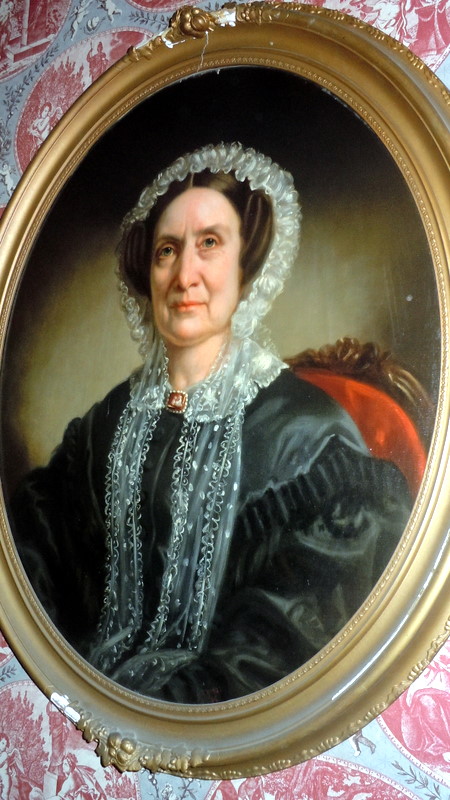
19th century portrait of a lady.


                                          19th CENTURY STYLE: 1801-1900.
        Ladies cloths of the 19th century -1800's-were  Victorian inspired. They tended to reflect the British influence, of Queen  Victoria . She reigned for 63 years and fashion changed numerous times. In the early 1800's- all cloths were hand made, making them expensive. Most Victorian ladies had about 3 dresses. One for  work, or a day dress, one for going out, or a walking dress and one for evening, usually a  ball gown.The introduction of the sewing machine in mid century,simplified dress making and enabled fashion to be extended. When  a machine was invented to make lace,dress styles scored and ladies found they could have many dresses in many styles.  In the 1890's- women's  fashion became simpler and less extravagant .  Bustles and crinolines  were no longer used and the dresses were not as big and full.At this time skits took a trumpet shape and tops had  high necks and puffed sleeves. In 1870's tea gowns were introduced for formal ware and entertaining. Many had low necks and short sleeves with lace trim. Older ladies seemed to prefer a high neck with a lace ruffle right under the chin.  Large jewelry pieces were wore at the breasts. Older ladies chose rich darker colors while the younger lasses wore pastels.These dresses were called."toilette de Reception",  in European circles.  


20th century portrait of a lady.


                                            20th CENTURY STYLE.1901-2000
     The 20th century brought for the first time ,women's clothing that reflected more of American taste than European taste. As a country, we had now been here long enough to have original  trends. European taste were still an influence and always will be, but for once, the American ideal could stand alone. Toward the end of the 20th century, the style of American fashion kinda went a little backwards. The long dress length that had seemed to have gone away were back. Most well dressed ladies still wore a long evening gown when they went out in the evenings. Cloths took on a simpler look, yet still maintained a elegance. Straighter skits and loose fitting bodices with a drop waste became the norm. Lots of heavy jewelry was worn and fur coats and wraps were of the most importance. Ladies still seemed to cover their hair with a hat. In the daytime heavier  hats were wore for walking about and in the evening the ,"cock tale hat," became the thing. Gloves were always worn when going out in public. Short ones for day and long elbow length ones for night. In the "Roaring 20's," ladies  started taking a little more freedom with there dress styles. Short lengths, no sleeves and lots and lots of shear fabric. They still continued to cover there head some what, even if it was just a feather or a jeweled ornamentation. The 20th century has brought more changes to clothing styles than any other century before. I think we can say this was because of the role that women were now taking in society.Women still wear hats today, but mainly on special events or to keep the sun out of there face. I think we have finally became free from the ideal that a women has to cover her hair. It has only taken hundreds of years.
       I hope you have enjoyed my little trip, through the past four centuries.  Portraits have and will always be a part of  our history. Today more and more are being done with a camera especially as cameras develope and get better, I am sure this trend will even get stronger. I think it is wonderful that our United States Presidents and First Ladies, still have formal oil painting portraits done. This is a wonderful way to preserve and share our history as a nation.In between times we can  enjoy the old portraits from the past. I love sharing mine at, My Old Historic House. Please drop by anytime for a tour, I will leave the lights on and Sissy Dog will always meet you with a jump and a kiss. Smile for your portrait!

Wednesday, October 26, 2011

It's just Brilliant!


    From the end of the 18th century to about 1820, when glass cutting became a commercial production, a great number of pieces were made in small shops by individual crafters, who cut and decorated blanks of glass pieces, that were blown somewhere else.
    Patterns in cut glass are geometric and determined by that process.Early American cut glass patterns were taken from English and Irish cut glass. These  were the only patterns possible, as curves could not be cut.
   Bakewell and Company,1808-1882, of Pittsburg, were the first American Companies to make cut glass commercially.
    In 1818, the New England Glass Company was founded and from the start ,a cutting department. with cut glass mills, ran by steam, were very profitable. Most work was done from pattern books with over 400 designs.
    Cut glass continued to be fashionable and the desired glass, by all who could afford it, until the first part of the 21st century.
    In texture and design, American cut glass of the last half of the 19th century was unequaled by any in the world. Over 60 manufactures from the  Mississippi to the Atlantic, were producing cut glass. The industry was centered in Pennsylvania, New York and Massachusetts.The glass was of the finest flint and the incisions were clear, clean and sharp.the the patterns  were heavy and BRILLIANT.
     Glass is a remarkable substance born of sand, alkali and fire.Glass has been produced for more than 3,500 years.Cut glass is glass that has been decorated entirely by hand, by use of a rotating wheel. Cuts are made in other wise completly smooth surface of the glass but artisans, Various sized metal or stone wheels , and running water,  are used to do the cutting. Cut glass can be traced to 1,500 BC in Egypt, where vessels of varing sizes were decorated by cuts that were believe to have been done with metal drills.Artifacts dating to
the 6th century BC indicate that the Romans had mastered the art of glass cutting.


   The first cut glass in America has been traced back to Henry Stiegil, an immigrant from Germany, who founded the American Glass Company in Pennsylvania.
    During the 18th century  high grade deposits of silica were discovered in America,leading to glass making being  vastly better than glass made in Europe. About the same time, natural gas furnaces replaced coal ones and electric motors replace steam, making it much easier to cut and control the glass. At this time cut glass became a symbol of elegance and leisure and demands for beautiful glass products,spurred intense competition and creativity with in the industry
    The BRILLIANT  PERIOD of cut glass was the late 1800's to early 1900's and it brought about many changes in cut glass. Stunning new patterns, quite unlike the earlier European designs ,were developed and patented. Fine cut glass was soon sought after by wealthy Americans. By the late 1800's prizes were being won all over the world by American glass makers,
  American cut glass during this Brilliant period became the choice of Kings and Presidents. The Presidents of America, Mexico and Cuba, fancied this cut glass. Pieces of Lincoln's cut glass, are still on display in the dish room at the White House today. Edward VII of Great Britain was a big lover of the American Brillant cut glass.
  Since true cut glass is entirely hand decorated, high labor cost made it expensive and out of reach to all but the wealthy. The introduction of pressed or  pattern glass, lead to the demise of the cut glass industry. During the hay day of this period there were more than 1,000 cut glass factories and by  1908 there were barely 100. From 1908 to 1915 some of these cutters created some of the finest designs ever made of cut glass. Glass of this period is heavy, cuts are deep and the pattern is Brilliant, when held to the light. There never has been anything to equal this since. In Ireland the Waterford Glass Company has managed to stay alive and do pretty good, but just last month, it was announced they were closing there productions..  Waterford glass is loved and collected by many, but to me, it is nothing ,compared to the old Brilliant Cut glass. I lost interest in Waterford, when they began to sell things at TJ Max and Home Goods.


    I have never been a big time collector of the American Brilliant Cut glass, I am , however, a lover of it.. When I was younger and starting out, these cut glass pieces were over the top as far as prices went. I have always loved it and bought and sold many pieces. I especially love punch bowls and lamps. I have never felt I could find either one at a good price that would make it affordable for me to keep. Punch bowls with stands in perfect condition still sell for thousands today. Some with miner chips still command hundreds of dollars. Large cut glass lamps, with prisms,  from this period , can also go for thousands. Smaller, not so great ones sell for hundreds. I have had a few of not so great ones, always sold them and have always been looking for that great one. Found one once in New York, but the price tag of $10,000.00, made me leave it . Like my mother always told me, "Go first Class, or stay home."
   Cut glass chips and breaks very easily and must be handled with care,  a sudden change from hot to cold, can make it crack. Pressed or pattern glass is much more affordable, and doesn't require the gentle care that cut glass does. It has much of the same effect when used on a table, and prices are far less.
    Like a lot of other antique items, cut glass has gone done in price. Very few of the younger generation know what it is, nor do they care, They have grown up in the plastic world and seem to not mind it . I still find that the big, rare, signed and unique pieces still command a pretty good price. Average pieces like, vases, water pitchers, bowls and  a common bottle, can be found at very low prices. I have a few pieces that I have found here and there ,at those low prices. I like to use them when I serve or entertain. To me this is the most elegant glass one can use. The sparkle or Brilliance is equaled by no other. When the light hits a piece, it cast prisms about the room.
   I hope you can come by some day and visit me and Sissy ,at My Old Historic House. I will leave the lights on and Sissy Dog ,will always meet you with a jump and a kiss. And I will serve us up something good ,from a Brilliant piece of American cut glass.Keep on shinning!


This cut glass piece has a sterling top.